
Fayetteville St. Looking South, Raleigh, N.C.
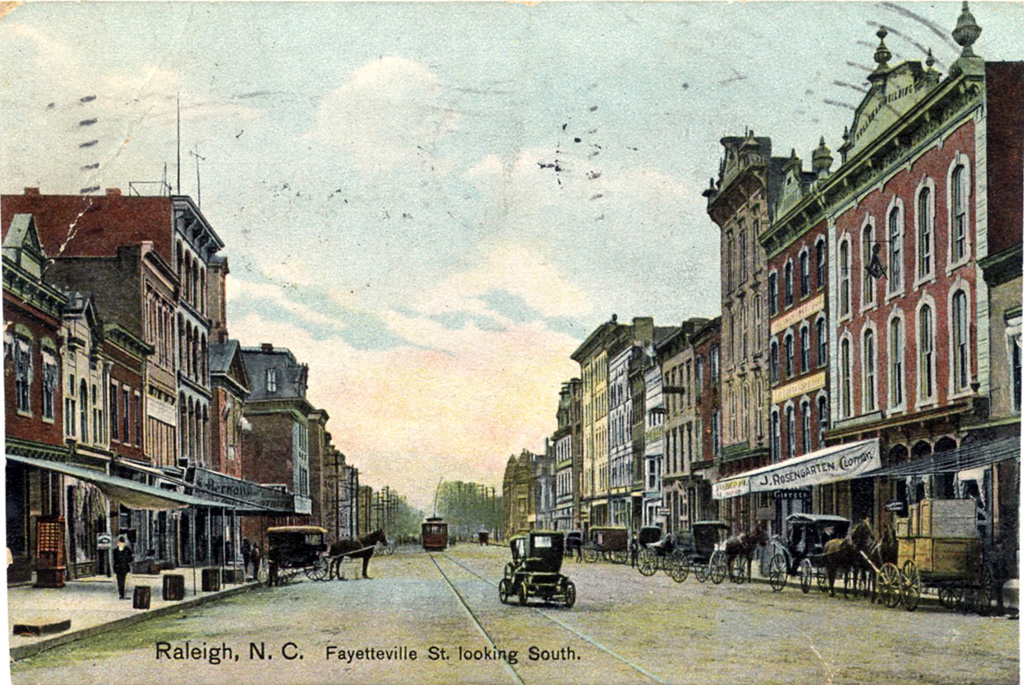
Buggies, streetcars and a classic horseless carriage — a vision of  Raleigh’s Fayetteville Street of more than a century ago. This week Flashback Friday features this nostalgic postcard view of  North Carolina’s Main Street .
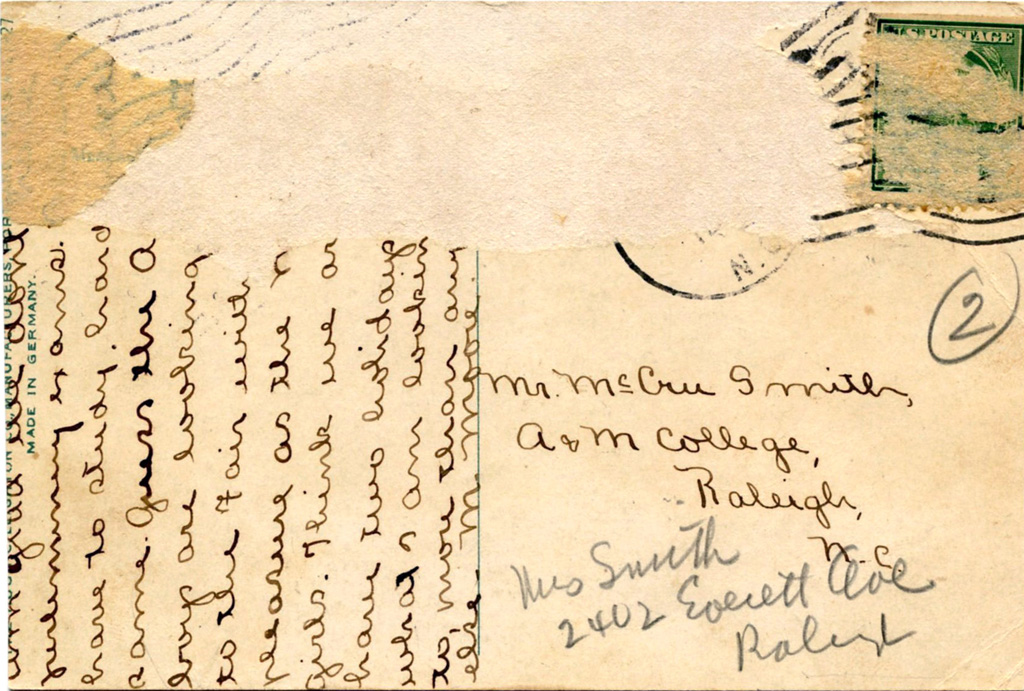
Apparently this postcard had been pasted into an album at one time, and its later removal resulted in damage to the reverse side. Judging from what is left of the Benjamin Franklin postage stamp and the postmark, I’d say this card was mailed ca 1909-1912 from somewhere in North Carolina. Here’s my attempt to decipher the message.
Am glad we don’t [have] perliminary [sic] exams. [But we] have to study hard [just the] same. Guess the A[&M] boys are looking [forward] to the Fair with [the same] pleasure as the M[eredith girls.] Think we a[re going to] have two holidays [illegible] what I am lookin[g forward]  to more than any[thing] else. M. Moore
So how did I do?
This week’s beautifully tinted view card was a product of German artisan printers of the early 20th century.
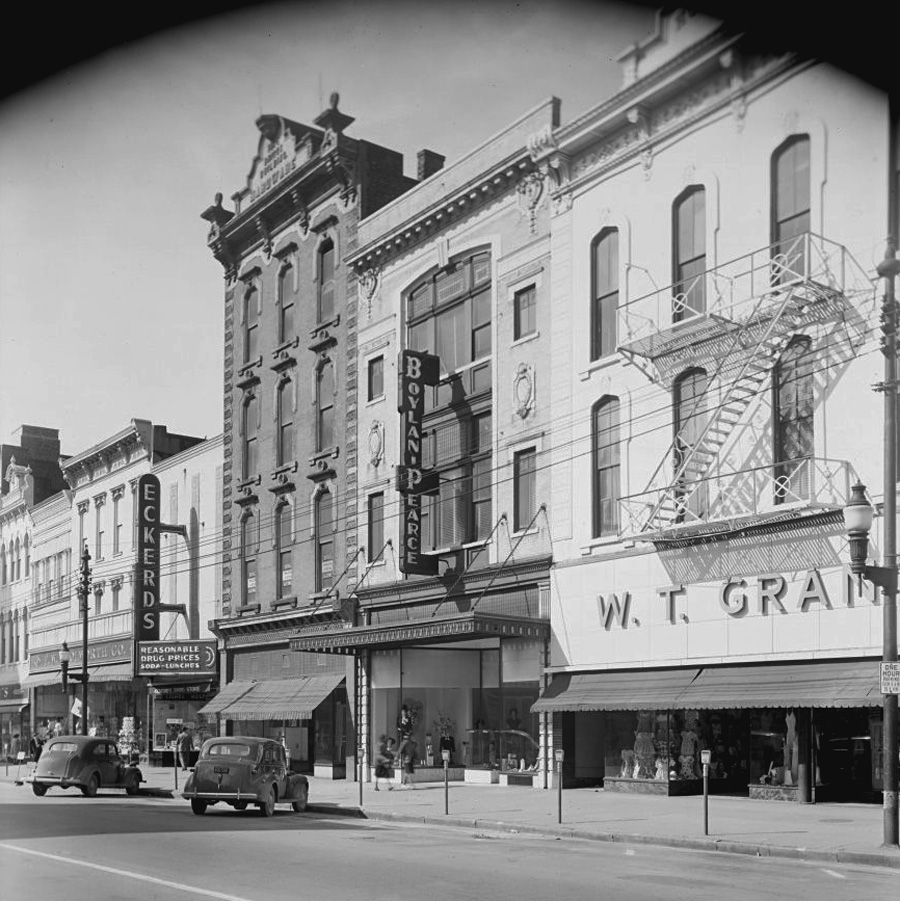
Below is a similar view of the 200 block of Fayetteville Street as seen in our postcard. This photo was taken in 1932. The streetscape looks much the same, but noticeably different is the presence of the 1913 Boylan Pearce building and all those cars!

State Archives of North Carolina photo
Another photo captures the view as seen in 1948.
State Archives of North Carolina photo
Fayetteville Street has been a dynamic part of Raleigh’s urban environment since its inception in 1792. Devastating fires ravished it in the 19th century; it has witnessed countless parades and celebrations over the years; it was the focal point of the civil rights movement in the 1960s; it was ‘malled’ over in the 1970s; it was a ghost town in the 1980s and ’90s; and it was restored as a downtown thoroughfare in 2006. Today, Fayetteville Street is yet what it once was and always has been — North Carolina’s Main Street.
Author’s note: The damage to the back of this week’s postcard, notwithstanding, we were able to determine from the card published in our 2012 article ‘Baptist University for Women,’ that the publisher of our Fayetteville Street postcard was The Hugh C. Leighton Co. The clue? In tiny type — ‘Made in Germany.’
Our Flashback Friday postcard this week was published by the renowned Hugh C. Leighton Co. of Portland, Maine.
The Hugh C. Leighton Co.  1906-1909
Portland, MEA printer and major publisher of national view-cards, especially scenes of New England. They printed most of their cards in four distinct styles usually employing tinted halftones. Most of their cards had a subdued but recognizable pallet. While some cards were printed at their plant in the U.S. most were manufactured in Frankfurt, Germany. Almost all their cards were numbered. They merged with Valentine & Sons in 1909.
“Flashback Friday†is a weekly feature of , Goodnight Raleigh! in which we showcase vintage postcards depicting our historic capital city. We hope you enjoy this week-end treat!
 Like us on Facebook
 Follow us on Twitter
 Subscribe to RSS feed
 Subscribe to posts by Email
 Sign up for the Newsletter
05/02/2015
Brigg’s Hardware is pictured in each photograph. I just read that it is closing: http://www.wral.com/historic-raleigh-hardware-store-closing-its-doors/14611075/
05/07/2015
once they moved out to Atlantic Avenue (too far out for the downtowners; too far in for the suburbanites), the store was basically doomed. I tried to shop there when I could, but lately the place looked more like a flea market inside than a place that was actually trying to make it as a retailer. I think if they’d held on in downtown Raleigh for a few more years, it could have become a destination store for the burgeoning downtown population. As it was, moving to a shabby, generic commercial building not close to any population at all doomed it.