
The Most Reclusive Building Downtown
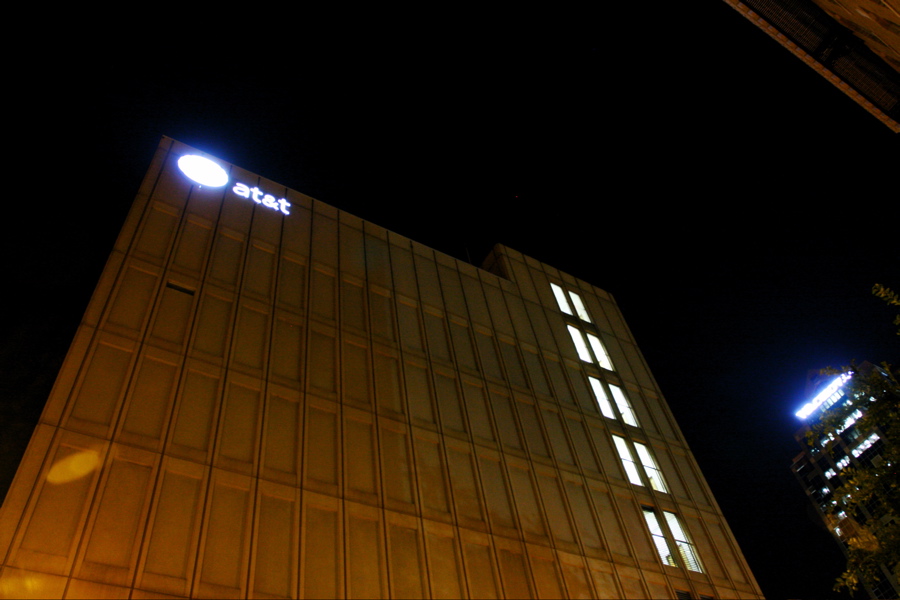
Every city has its share of buildings considered “eyesores”, and the AT&T building (former BellSouth building) certainly qualifies as that. Built in 1948 and standing 8 stories tall, it creates a virtual pedestrian desert on the block bounded by Hargett, McDowell, Morgan, and Salisbury Streets.

Cited by Dana at gogoraleigh as part of a “downtown concrete canyon”, it is certainly one of the least appealing buildings of Raleigh. It was mentioned in his series of suggestions to build a better downtown:
A second step toward correcting this block is for AT&T to move their operations to another site. Certainly today’s microtechnology doesn’t require such a massive complex, and could either be rearranged on site or relocated off-site. The classic building at McDowell and Morgan could either be renovated or replaced with something more conducive to downtown life.
Unfortunately for those who would like to see this space put to better use and AT&T to move on to less prime real estate, it’s not going to happen. I recently spoke with an AT&T technician who has spent a good amount of time in this building, and he explained why it will probably be sticking around for our lifetime:
All the copper wires that go underground are all centralized to that building. If you were to take the building up, it would be nothing but a giant plate of copper. If the building was blown up, you’d have to rebuild it, in the exact same spot. There is too much copper going underground to that spot for that building to go anywhere. As long as there are telephones and internet, that building will be sitting in that spot.
All the downtown copper leads here because it is a switching station, serving as the backbone for the vast majority of telecommunications in the region. There are several floors that are nothing but hundreds of thousands of cards that route voice and data traffic, as well as provide dial tones. The ground floor consists of a series of generators and exhaust vents — if the power goes down, communication must continue on its own power.

Also contributing to unappealing nature of the complex is the radio tower above. The same AT&T technician said that it was no longer in use.

The tower is connected to the building via a rickety bridge (above).

View of the city from the top of the tower
It’s sad that a valuable piece of real estate with so little pedestrian value is a permanent fixture of downtown. Its central location could really transform this “concrete canyon” of a block sandwiched between Nash Square and Capitol Square.
There is no reason why it needs to be located here. It isn’t often I say this – but despite its age, this building should be demolished. The very specialized use that it has been put to over the previous 6 decades means that rehabbing or repurposing it would likely not be practical.
Sadly, this building isn’t going anywhere. We’re stuck with it and it will continue to be a sterile and boring part of the downtown landscape for some time.
 Like us on Facebook
 Follow us on Twitter
 Subscribe to RSS feed
 Subscribe to posts by Email
 Sign up for the Newsletter
07/21/2009
There’s no reason it needs to be there, except for all the existing telecommunications infrastructure that leads to it. You’re right in that moving it is pretty much impossible.
But I disagree that the building can’t be rehabbed. I think Dana is on to something when he talks about restructuring the building (he’s on crack when he talks about moving the location, though). Even assuming that there’s been equipment added over the course of the building’s life (and I’m sure there’s been quite a bit), electronics _have_ shrunk a lot since 1948.
It’d be interesting to find out the structure of the building to determine even what was possible.
07/21/2009
Oh, and if the tower’s no longer needed, take it down, or at least take the big-ass microwave cones off of it.
07/21/2009
I took a tour of this site in the late 70’s when a student IEEE member, and when they still used electromechanical switches on most of the switching room floors; the noise was literally and truely deafening. A couple of rooms had been converted to pure electronic and were quiet except for air conditioning noise. But to me most impressive were the battery rooms in the basements (multiple levels below ground), which could continue to power the lines in the event of a outage. People forget that – as nowadays when the power goes so does landline phone access for most – those still with pure analog connections (including phone power) will continue to be able to call and receive (tho the ringer will not “ring”).
From memory I do agree that the upper floors could be removed, or at least opened, as they housed only offices. But this is a building in name only. It is more a vertical bunker.
– Michael, ex-Raleighite (1958-1978)
07/21/2009
Good thoughts but I’m actually in favor of leaving the tower up unless it becomes a danger to pedestrians. One day, tech junkies may have nostalgia looking at the ‘old way of doing things’. I guess I wouldn’t cry if we lost it.
Also, while the building is ugly as hell, the insane copper network can only be a plus to downtown in the future. It may be a hub for a future technology we have not seen yet. (glass half full)
07/21/2009
or, if the price of copper continues to escalate, we could sell the stuff!
07/21/2009
I think every city has a central office like this, some are a lot bigger. I like this one in NYC http://en.wikipedia.org/wiki/33_Thomas_Street
07/22/2009
> I like this one in NYC (@33_Thomas_Street)
Awesome Wikipedia article – thnx.
It’s a long distance exchange (now meaning carrier exchange, like MAE-East/West of the internet world) and not a CO, and houses three of the largest telephony switches ever created – 4ESS. Later switches were smaller and modular, so these were the USS North Carolina or Antonov An-225 of telephone switches.
stats from Wikipedia:
“The floors are also unusually strong, designed to carry 200 to 300 pound per square foot (10 – 15 kPa) live loads.”
“William H. Whyte claimed that it features the tallest blank wall in the world.”
“It is often described as one of the most secure buildings in America, and was designed to be self-sufficient and protected from nuclear fallout for up to two weeks after a nuclear blast.”
Heh – it never was tested thank goodness. Tho when there’s a building fire housing an ESS switch it’s really bad nows…
07/22/2009
I’ve lived in Raleigh all my life and had no idea this building was that old. I figured in was built in the late ’60s. I can’t believe it’s been there since 1948.
If I recall correctly, there’s a similar building/eyesore in Birmingham just up the street from the Civil Rights Institute.
07/23/2009
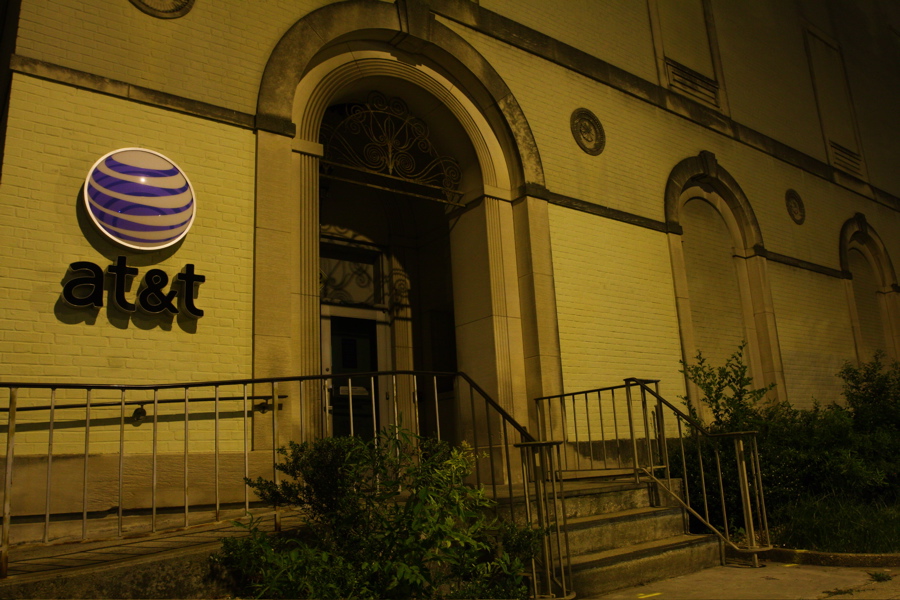
Has it always looked that way? Much of the first floor has those big arches that look like fancy windows that have been bricked-up. At the very least, it’d be nice if they were converted back to windows again…to make it feel more like a normal building.
07/23/2009
I heard that it used to have windows, but were sealed for security in the 60’s or 70’s. Check out the Professional Building across the street. It still has an original Art Deco flair inside.
07/24/2009
at&t should commission an artist or artists to decorate that building and make it more visually interesting.
I can look out the windows where I work and see that monstrosity…so a change of scenery would be nice.
07/24/2009
As I recall, in the mid ’60s the original, 3-story, 1948 brick structure at the corner of Morgan and McDowell still had windows in the now sealed-up openings. The building was unpainted, and the natural brick walls accented by natural limestone architectural detailing was really quite attractive.
In the late ’60s or early ’70s, a large steel-framed concrete addition raised the height of the building by two floors, and the window openings in the original structure were bricked up. Shortly thereafter the entire building was painted a drab gray (now it is a drab beige). Subsequent additions added in the ’80s and ’90s gave us the windowless behemoth we see today. Whenever I go by there now, the building’s cold and univiting appearance evokes an image of cold war East Berlin. So yes Michael — one great expansive bunker.
07/27/2009
Thanks Raleigh Boy.
That explains why I don’t remember that building as being as old as described. At some point during my youth, it went through a complete transformation. The upper portion shown in photo 1 looks much more modern than 1948.
08/06/2009
It’s true, nearly every major city in this country has one of these big AT&T monoliths down town. When I first saw one of these it left a similar impression as the author’s. A little research revealed that the building was built in that way in order to protect sensitive equipment, so your phone calls could continue to come through crystal clear (something that has lost value since our adoption of cellular convenience).
I’m sure everyone would love it if Raleigh could look like a sea of restored cotton mill apartments, high-rise condos, and abandoned-but-beautiful art deco offices. Personally, I’m much more concerned with the influx of new structures that are poorly conceived and lack integrity of design and purpose–I even question the transformation of classic buildings in to condos and office spaces, as I’d much rather see them serving their original purposes.
A city shouldn’t be built like an arbitrary creative class (*YUP 2000) playground. A city is an ecosystem. The AT&T building was designed based on a specific ecological need. Unlike other buildings, its ugliness can’t be chalked up to Gen X tastelessness and the marketing-to-mediocrity of the last two decades. This building is now a monument to the cold, hard necessity of post-war America and mid-century technological innovation.
That said, the building and its purpose are clearly out-of-date, and a city should certainly evolve to suit new needs. Perhaps the building could eventually be replaced with something akin to Shanghai’s Oriental Pearl Tower? Until then, however, this building shouldn’t prompt bad-mouthing when there are many newer concepts that are much more deserving.
08/16/2009
These central offices can also contain cellphone switches and internet backbone gear too, so just because you don’t have a landline, doesn’t mean they should knock the building down.
08/22/2009
The Eisenhower Administration asked AT&T to harden all their central offices against the electro-magnetic pulse from nuclear weapons.
Thankfully, that never happened, but AT&T wound up with alot of ugly buildings. They have tried to re-model some of their buildings since the newer technologies take up much less space, but they are often stuck with bricked-up windows and faceless facades.
09/09/2009
I always wanted to know what was in that building. I remember walking past it as a kid coming from Halifaz Court, headed home to Walnut Terrace. You could hear the humming noises from the sidewalks.
10/23/2009
These comments are so funny. I never knew people cared so much about these buildings one way or the other.
Before I came to work for the phone company I never paid any attention to these buildings, in the phone comany world they’re called Central Offices or COs for short. They have few if any windows and they are built to take bad weather and nuclear attacks. As tough as they are we still lost a few in New Orleans from Katrina.
Every city has them, you just might not notice. Look for buildings with no windows and an at&t logo on the side and you can bet it’s full of phone equipment.
And yes, downtown Birmingham has a giant one across the park from the Civil Rights Institute.
12/04/2009
Any chance they could punch some windows into the walls, or would that compromise the structure?
11/10/2011
i have noticed these buildings in many cities, always without windows. i’ve been told (this may be a myth) that they had no windows because the ‘phone company’ monopolies did not want switchboard operators looking out windows. any activity that took their attention away from the switchboards would slow down the operators’ productivity. switchboards and their operators were certainly around in 1948. is this a possibility?
04/26/2014
According to a tech at the Birmingham Ensley C.O. (not the Main & Toll one people are mentioning), windows were bricked up in the ’60’s on most offices due to the riots of the time. Later, due to the requirements for air conditioning with modern electronics, that was continued. But windows have been restored in some offices, such a Greenville, SC, Dial & Toll. There was a building binge in the late ’40’s and many buildings were grand ones, such as Charlotte-Caldwell and Greensboro-Eugene, but many were later just globbed onto with little regard for aesthetics or matching the original design, such as the unmatched bricks on the higher floors at Asheville-Ohenry. These buildings were designed to last for centuries, including storms and earthquakes and if anyone thinks Morgan or any other office is going anywhere without nature’s help, they’re wasting their thought time. Nevertheless, the city could put pressure on AT&T to put the original windows back in to soften the look a tad.
05/23/2014
As ugly as these buildings are, they serve a critical purpose. Function over form. These buildings will continue to be a necessity even as technology evolves. Many of these buildings have been partially re-purposed as data centers, which have very similar requirements.
No, there is no reason this particular building has to be located where it is … except that it is too late to do anything about that now. I’m sure in 1948 it made all the sense in the world to put it in that location.
I would guess there are things that can be done with the facade to “soften the look”. Windows are not the best option. We may no longer be living in the cold war but terrorist threats are very real. Consider what a truck bomb might do to a building with windows. Faux windows or an overlay on the facade might improve its aesthetic appeal without compromising its integrity.
The biggest problem with the building isn’t how it looks, it is how it interacts at the street level. There are plenty of examples of beautifully designed buildings that have the same affect as this building simply because it doesn’t interact well with the street. The problem is that this building was never intended to be nor should it be a public space. Since the location is critical then perhaps in the long term, a solution might be to take it underground, either at that location or adjacent to it and then demolish the above ground structure. No small engineering challenge but certainly achievable. Needless to say … ATT isn’t going to do it since it offers no benefit to them.
10/10/2015
“There is no reason why it needs to be located here. It isn’t often I say this – but despite its age, this building should be demolished. The very specialized use that it has been put to over the previous 6 decades means that rehabbing or repurposing it would likely not be practical.”
Don’t be a dolt. Its purpose is literally the exact reason it needs to be exactly where it is. Just because you don’t like it doesn’t mean it shouldn’t be there. Build around it and it will blend.
These buildings still service mobile networks, and in the internet age, more and more of these buildings are turning into secure hosting/colo facilities for servers for internet companies/startups, because they’re not only inherently secure, but centrally located (reducing latency), and can handle the power requirements and weight of serious computational infrastructure.
Telephones and internet aren’t some magical thing you can just stuff under the bed so no one has to see it, it takes considerable resources to make communication possible whenever you feel like it for millions upon millions of people. Sorry to get all aggro but you might as well embrace it because they aren’t going away
11/19/2016
The posts above save alot of my breath.
AT+T’s brutalist architecture is not so employees can’t look out windows. Telephone company employees are treated very well. It’s protecting the equipment inside from attack, disaster, and other service interruptions that matters.
Telephone buildings like this are public service establishments, and keeping people in communication is a serious business.
AT+T helped build america, this building is amazing, and you guys should be happy for it.
The tower is awesome too..