Reminiscences of a Raleigh Boy: Part 5
Before It was Glenwood South
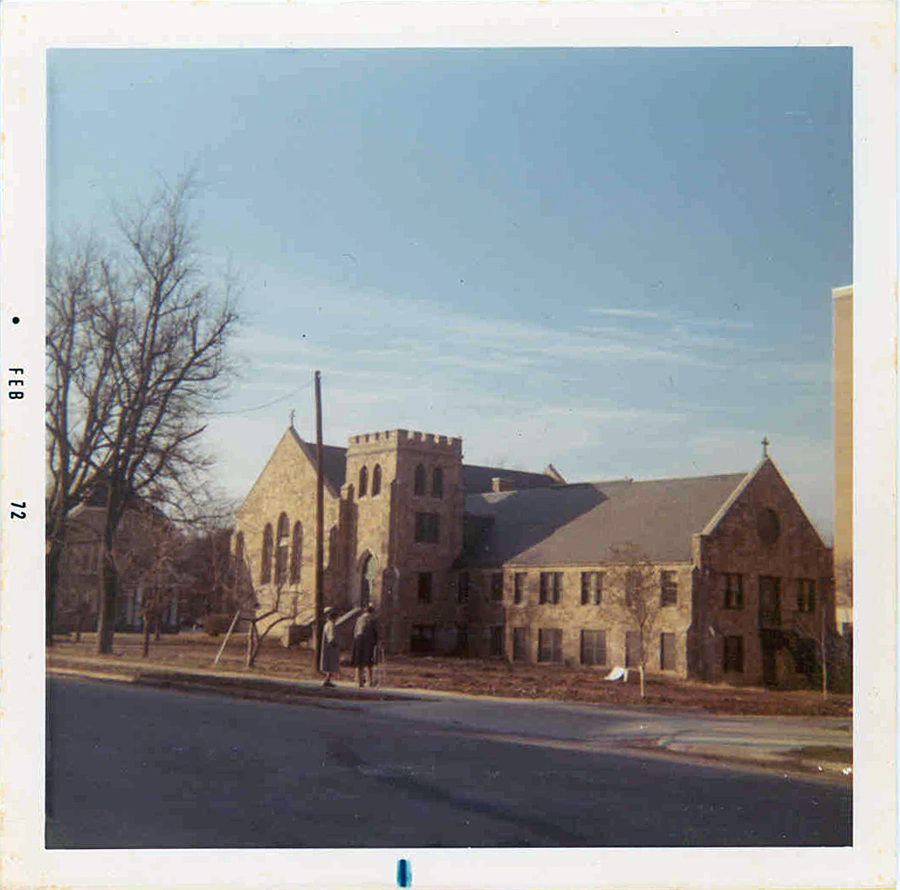
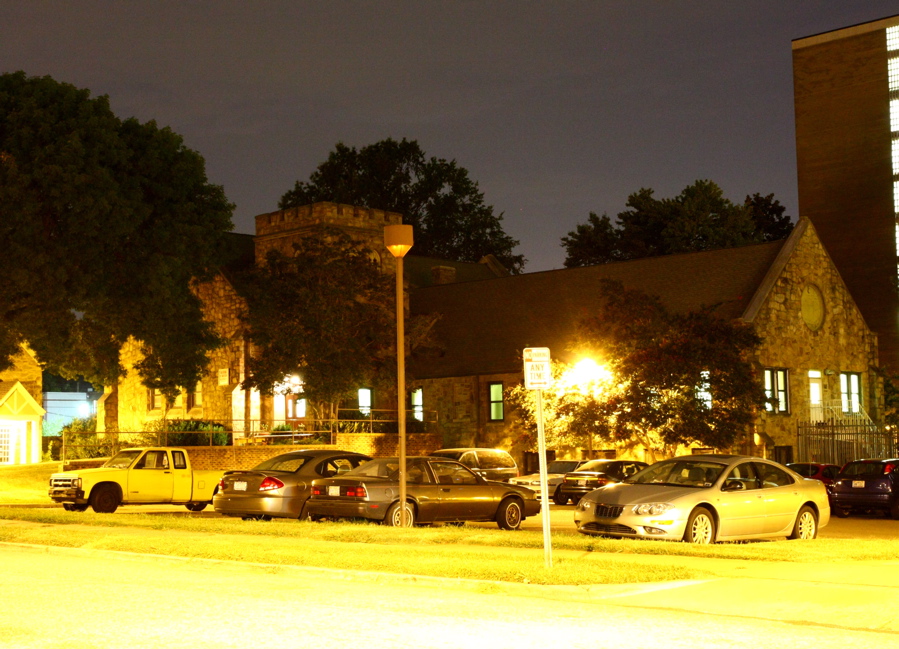
This is how Ravenscroft School looked in 1972, right after the seniors complex was built. It had remained virtually unchanged since my days there in the 1950s. The buildings were converted to office use shortly after this photo was taken. Below is the view today.
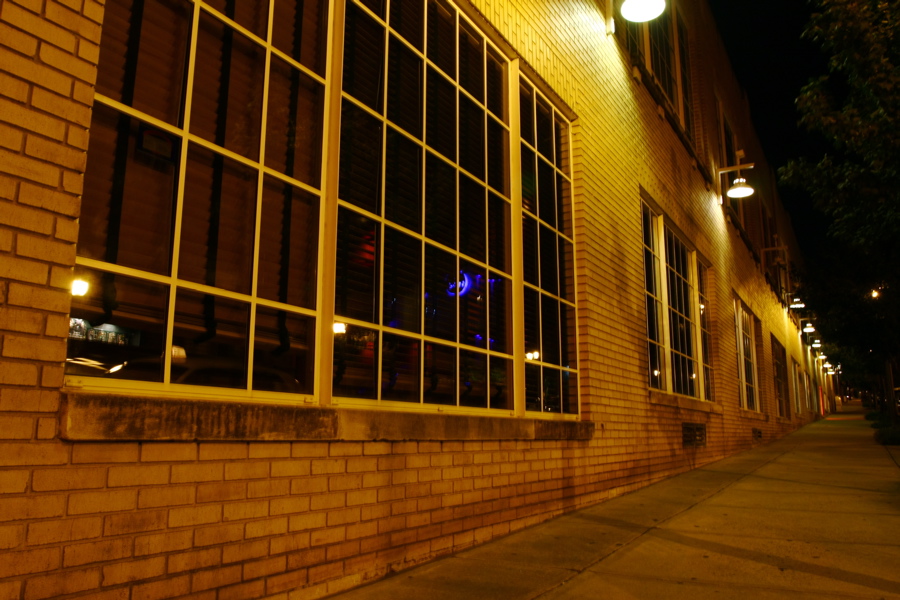
Last week I attended the Blogger Bash hosted by Ginny Skalski and Wayne Sutton at the Edge Office over on Glenwood Avenue. Afterwards, John Morris and I stopped in at a nondescript bar on Tucker Street around the corner from Solas. As we were sitting on the outdoor deck sipping our brew, engaged in heady conversation, John asked me if I remembered Glenwood South when it was primarily a commercial and industrial area. (He relocated to Raleigh just four years ago, so he knows the area only as the entertainment district it has become in recent years.)
Well! It just so happened that the deck we were sitting on is across the street from what is now Glenwood Towers, a subsidized housing complex for seniors. I pointed to the old stone buildings adjacent to the high-rise, which serve as offices for the Raleigh Housing Authority. That, I said, is where I went to kindergarten in 1956-57, when it was the Ravenscroft (Episcopal) School. At that time the school occupied the entire block. The two-story stone classroom building adjoined the stone church, where we kindergartners attended daily chapel. The headmaster lived with his family in the stone house next door. On the Johnson Street side an open creek ran the whole length of the block. A WW II-era Quonset hut on the grounds served as the 6th-grade classroom. And the sprawling playground was where the high-rise itself now stands. With its tubular-steel jungle gym, swing set and see-saws, ball field and “merry-go-round,” this playground was a 5-year-old’s fantasy land!
As I recall, that end of Glenwood Avenue was still all residential in the ’50s— except for the Pine State Creamery across the street. I was beguiled by that building back then, with its tall, yellow-brick corner tower lording over our playground. Seems like my class got a tour there once, and we were even treated to a sampling of ice cream. The low-lying area between the Norfolk Southern train trestle and the Seaboard tracks to the east was all houses. That part of town was known as Smokey Hollow. Back then it was a blue-collar neighborhood whose residents worked primarily for the railroad and other industrial businesses in the vicinity. Sometimes, when my Dad picked me up from school we would drive through there on our way home. I recall vividly the pall of smoke hanging over the place in the wintertime. Raleigh’s minor league baseball park, Devereaux Meadow, was located across Peace Street from Smokey Hollow. That venerable sports facility was demolished in 1979, and the city’s sanitation department occupies the site today.

Just beyond the Norfolk Southern trestle in this shot is where Smokey Hollow used to be located.
During the mid-1950s, Glenwood Ave. from Tucker south to Hillsboro Street, had begun transitioning from residential to commercial. Businesses such as auto garages, tire shops, upholsterers, plumbers and typewriter and TV repair shops occupied the storefronts along the street.
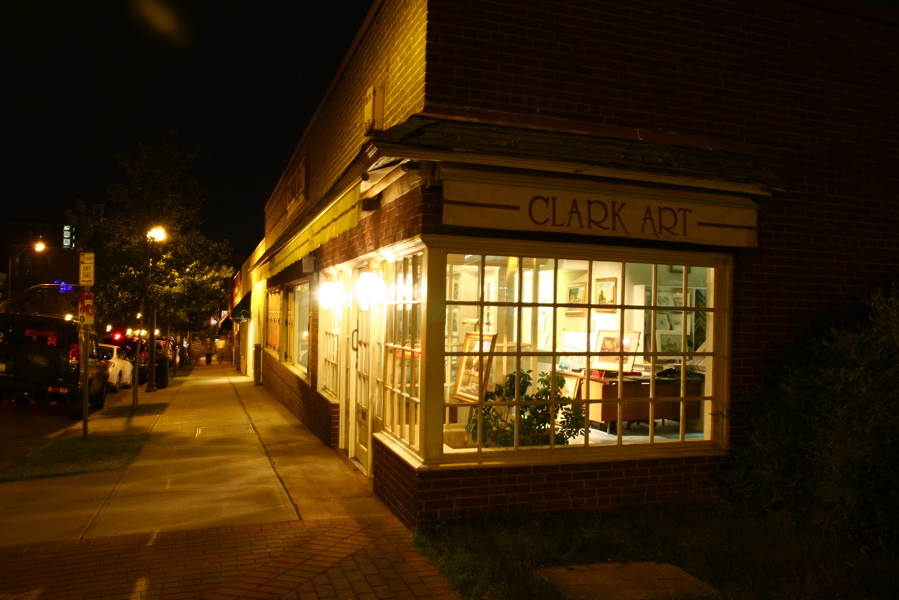
By the early 1970s the transformation was virtually complete, although a handful of houses and apartment buildings intermingled among the small businesses. At that time I was working as an awning technician and picture framer at Clark Art Shop, located at the corner of Lane Street, which dead ends at the tracks. During my lunch break I would often walk down the block to the Milk ‘n More Store for a pint of chocolate milk and maybe a pack of Nabs or a Honey Bun. The Milk ‘n More was sort of an outlet store for Pine State Creamery across the street. The TexMex restaurant on the corner occupies that store building now.
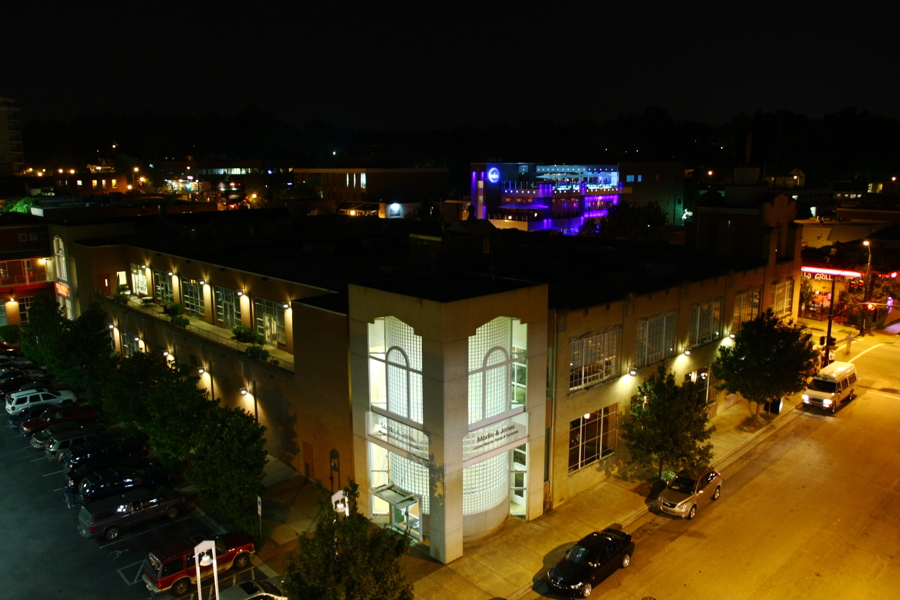
I can hardly visualize those days now, what with all the traffic and entertainment activity going on there, and with high-rise condos and apartment buildings sprouting literally on every block. A major entertainment hub now occupies the old Pine State building. Clark Art is still in business, though I think they no longer make awnings. And across from the no-name bar on Tucker St. is the Ravenscroft playground, where, in my memory anyway, a 5-year old Raleigh Boy still plays to his heart’s content.


Sign up for the Newsletter
John Morris
Raleigh Boy
Devin McKim
Sid Fowler
uliveandyouburn
Adrienne Taylor
Ian F.G. Dunn
Ben Spiker
Paul Friedrich
08/08/2008
Why no name?! I LOVE that bar! Its probably the most laid back of the Glenwood area bars.
Maybe its because no one really knows what the name is? I think they have like 4 names…
08/08/2008
Hey, hey…I’m not criticizing! The night we were there it was totally empty, which was kinda nice actually. I don’t remember seeing a sign with a specific name on it, hence my description. I’ll have to go back there and check it out another time!
08/09/2008
It can be PACKED at times… I would say it a favorite of students who want the environment of Glenwood, but the prices of Hillsboro St.
Most call it Around the Corner, however some call it Lucky B’s, or Lucky 13. The TRUE name is Lucky B’s Around the Corner. The B’s sign looks like a 13… and the bar is owned by a former Hurricane player, Bates Battaglia(now plays for the Maple Leafs) who wore the number 13 for part of his career. You can often find Bates and other Canes players at the bar during the offseason.
08/09/2008
Thanks for that info PPF25! Now I know. I will go back and check it out (sign or no sign)…The deck is a definite plus, and I like the way it is around the corner off the main drag.
08/12/2008
Wow. This is just awesome. My oldest memories of Glenwood South are of the Pine State building and a bunch of other industrial-type buildings in various states of defunctness and disrepair. I had no idea Ravenscroft was there, and I had no idea about Devereaux Meadows. Where was that in relation to Fred Fletcher Park?
08/13/2008
Defunctness! I love that Ben! As for Devereaux Meadow (named after the Devereaux estate which was up on the hill where the Glenwood neighborhood is today), the ballpark was exactly where the city garbage truck garages are today, between Peace St and Capital Blvd. Nothing is there now that would give away its previous existence. A friend of mine has photos of it before it was torn down, and I will post them soon as I can. (He lives in NYC, so it might be a while before I can get them!) Fred Fletcher Park was created by the city back in the 1980s when the old Methodist Ophanage closed and was demolished for condo development. It is off Glenwood Ave. at Cleveland St. and was also originally part of the Devereaux estate.
08/27/2008
I went to Devereaux Meadow as a boy with my dad. And of course I remember pine state creamery on glenwood. Nice post.
09/07/2008
I probably have all you ‘youngsters’ beat on memories of Raleigh from
‘way back when’.
RALEIGHBOY: I have a great personal interest in obtaining copies of photos
of Deveraux Meadows Ballpark, should you receive them from your
buddy in NY. Please post my email, if you ever put them on this site?
I have researched and exhausted all resources over past months, in
hopes of finding Deveraux pics…found they are almost non-existant.
A million thanks for your help.
Fred Fletcher used to do Halloween Party Night at Deveraux
onstage each year throughout the late 40′ and 50′s. What memories
of simple fun times! A ‘family affair in atmosphere’, prizes for costumes, contests, parents with most children present, etc. My mom once won
five gallons of Pine State vanilla ice cream! She and her brood of five
thought they had died and gone to heaven. :)
Times were very hard on
people living in that vicinity, and Fred brought a night of true entertainment
for the crowds in the bleachers.
I Also have friends and a brother, who played many a baseball
game there, pitching and rolling in clouds of red clay dust. Would
love to surprise them with pictures of Deveraux Meadows.
Am glad I found this site, and will pass it to others, Deda
02/08/2009
Regarding Deveraux Meadows – my mom and dad used to play tennis there back in the… 1940′s. Would love to see it featured – oh I have pictures taken of mom and dad and family members playing there back in the day if they would be of interest.
And remember, Broughton played football there back in the 60s. My brother did a wonderful pen and ink drawing of the old ball park…
02/09/2009
A couple of comments and a question.
I believe some of the buildings occupied by the city as garages for their vehicles were a part of the old Devereaux Meadows complex. They’re the brick buildings that back up to Capitol. I’ve been inside of them and they certainly appear to be much older than 1979. One even has a locker room with showers, a locker, and an old round funky looking handwashing station for multiple users.
I’ve heard that old timers referred to the property at “Mr. Devereaux’s meadow” or “old man Devereaux’s meadow” before it was a sports complex and the name stuck.
I’ve also heard that Wills Forest Street, on the hill above the meadow and turning west off Glenwood, was named after one of the Devereaux’s enslaved workers, who had his home in the area.
Now my question: Did Smokey Hollow not extend a ways past Pearce on up what is now Capitol Boulevard? I had always heard that the black section of Smokey Hollow, north of Peace along Capitol up through the Wade Avenue overpass, or thereabouts, was razed to make way for what would become “North/Downtown Boulevard” (later Capitol) and that all of the residents were relocated to Halifax Court, a housing project that used to be behind Peace College. The last three or four of those building have been torn down in the past few months.
02/09/2009
Deda and Fran– Thanks for sharing your memories! And, sure– we are interested in seeing your photos! Please contact us through the site’s ‘contact’ function.
NCSU– The Devereaux family occupied a huge antebellum mansion located on the hill above the meadow. The Glenwood neighborhood is there now. I’ve heard the story about Will’s Forest, too. You may have noticed the streets are named for US presidents– but why do you think one –Tilden St– is so named? Extra points if you know the answer!
Pigeon House Branch once meandered through the meadow. When the stadium was built as a WPA project the creek was channelized. Today you can still see the 1930s stonework of the channel. I’m not sure about the brick buildings being a part of the “complex.” It doesn’t seem likely, but then, I’m not sure. The stadium itself was obliterated when it was demolished. If you googlemap a satellite view of the site you can see its foot print clearly defined by the parking area for the city trucks.
As far as Smoky Hollow– It covered basically the whole low area north of North St., east of the Norfolk Southern tracks, west of the Seaboard (CSX) tracks, and south of the Raleigh Cotton Mill (now condos). In 1955 or so Capital Blvd was put in and took out a large section of Smoky Hollow in the area between the cotton mill and Devereaux Meadow. Peace St. was widened and realigned, which took out more houses. From my research I’ve found that blacks were concentrated along Peace near the tracks and along two streets in the center of the neighborhood which don’t exist anymore–Cary and Flemming, and along the eastern end of Tucker between these two.
02/10/2009
Re: Tilden Street – I don’t know the exact answer, but perhaps it has something to do with the developer’s attitude towards the Compromise of 1877, which occurred when the 1876 presidential election was thrown into the House of Representatives, and resulted in Democrat Samuel Tilden losing, “His Fraudulency,” Republican Rutherford B. Hayes winning, and the end of Reconstruction.
John, can you remember when Wade Avenue did not exist, or at least not in the route it follows now? I’ve looked at some old maps that don’t appear to show it until some time in the ’50s.
I REALLY enjoy this blog, and all of your insights, John.
02/10/2009
NCSU– Ding ding ding! You win the prize! Very good–I’m impressed!
Now about Wade Ave. This street was originally laid out as part of the Oberlin community in the 19th century. It was a residential street, running only a couple blocks long on either side of its intersection with Oberlin Rd. Much later, when Cameron Village was being developed in the late 1940s Wade Ave. was extended to Dixie Tr., where it stopped. Woods lay beyond that point. The Occidental Life Insurance Building (one of Raleigh’s signature modernist office buildings, btw) was built in the early 1950s, and Wade Ave. was widened and the Oberlin Rd. overpass was built, wiping out most of the residences in that vicinity. Around that time Wade was extended eastward from Oberlin Rd., under the Glenwood Ave overpass to its juncture with the then new “Downtown Blvd.” now Capital Blvd. Around 1960 or so Wade was again extended, this time pushing through the woods at Dixie Tr. to join up with Ridge Rd. and Ridgewood Shopping Center. During the course of its construction, my Dad would take my brother and me out there on weekends to check out the road’s progress. The new road cut a wide red clay swath straight through the woods for, what seemed to me, an interminable distance. I remember that like it was yesterday.
02/10/2009
Thanks for the info, Raleigh Boy. And although I wrote “John” in my previous entry – and do appreciate the work John Morris does here – I was actually addressing my comments to you.
Have you ever seen the strange little house on Jefferson Street? I think it’s about the second one on the right, east of Glenwood. You probably know what that used to be. Heck – you probably fed the dalmation! ;)
02/10/2009
Ha ha– that’s a good one! So I’m guessing that you already know it is a former RFD fire station. (I’ll have to look up the station number, though.) It was built in the 1920s and the city closed it in the 1950s. A friend of mine once worked for an architect who wanted to buy the building and adaptively rehab it for use as his firm’s office. The owner refused to sell, so now it still sits there, locked up and used for storage. At least it was last time I drove by there!
02/12/2009
There’s an interesting story in this morning’s N&O about 93-year-old Brady Jefcoat, collector, tinkerer, and former resident of Smoky Hollow, which he described as so tough “the canary birds all sang bass.” The paper says Smoky Hollow was “a low spot between Peace Street and Boylan Heights.” I don’t think that’s very accurate.
02/12/2009
NCSU– Thanks for the tipoff. The N&O is out of kilter on that one! I think I’ll email the reporter and include a link to this post! btw–I do intend on writing a post on Smoky Hollow at some point in the future. I have no photos of it, unfortunately, –I was very young when the neighborhood was cleared– but the story cries out to be written!
02/12/2009
Raleigh Boy -
Are you familiar a book called _Culture Town: Life in Raleigh’s African American Communities_ by Linda Simmons-Henry and Linda Harris Edmisten? It contains a small but informative section on Smoky Hollow.
02/13/2009
NCSU– Yes, I have that book –a compilation of oral histories about Raleigh’s black community, for those who don’t know. IMHO– the section on Smoky Hollow is so full of inaccuracies that it borders on fallacy. While oral history can be beneficial in interpreting the past, relying on it for historical fact opens the door to grave error. And forget that map on page 159 that puportedly shows the Smoky Hollow area– not even close!
02/13/2009
Very interesting RB. It’s been a long time since I read it. I’ll have to look at it again.
I usually eat lunch on Fridays with a group of “Ole Raleigh Boys.” Most of them are in their 70s. A couple are in their 60s. I am the “young’un” at the table and not eligible to belong to the formal group yet. It’s fascinating to hear them reminisce about “ol’ Raleigh.” (That “e” on the end of “Ole” has always bothered me!)
I can’t eat with them today, but next week I’ll ask them about Smoky Hollow. And of course I’d be interested in reading more from you on the neighborhood.
02/13/2009
Yes, I’d be interested in learning what they have to say. Ask them what they remember about the Devereaux Meadow ball park, too.
11/07/2009
Am late to this party; just stumbled across this website while surfing. Am a Raleigh native, daughter of a Raleigh native (who happens to be in Ole Raleigh Boys Club). Re Devereaux Meadow: when I was a student at Daniels Jr. High (1962-65), our football games were played at DM. Come to think of it, Martin Jr. High and Morson Jr. High (now long gone) played their home games there also. Re Smokey Hollow: I don’t recall ever being given a “tour” of Smokey Hollow but I certainly remember hearing lots of ominous stories about the area. I recall hearing a classmate (whose dad was an MD) talking about how her dad would not make house calls (yes, MDs made house calls in those days) in Smokey Hollow unless he could presuade a cop to accompany him. Am enjoying making my way around your website…great work!
11/07/2009
Raleigh Girl
Better late, than never, right?.
Yes, I was at Hugh Morson in my jr high years. I loved that building– and the teachers.
Hope you enjoy your stay on our site– Thanks!
11/07/2009
I’m often reminded of the old Hugh Morson building…like once a week after my trip to the City Mkt. when I pass by the gargoyles (saved from HM exterior)near the Federal Bldg. on New Bern Avenue/Person Street. My only memory of being in Hugh Morson is when Daniels played them in basketball. OTOH, maybe I’m losing it; maybe those games were played in the (then new) Enloe gym?
03/16/2010
During the 60′s, the Raleigh minor league baseball team that played at Deveureux Meadows was at different times the affiliate of the Phillies, Pirates, and Cardinals. I remember Stan the Man Musial Night, Bat Night, Max Patkin (the baseball clown), chasing foul balls behind the bleachers and fighting other kids for them in the kudzu on the hill behind the concession stand. Remember the stone dressing rooms for the players, and the restroom that was just one looooonnnnng urinal in the floor? I remember hearing those baseball players walking from the field to the dressing room with steel cleats on the concrete walks, and thinking they were bigger than life. I think it cost about $1.00 for adults and 75 cents for kids. Dad would always say my brother and I were “under 12″ so the ticket price would be cheaper, even after we were maybe 15 or 16 years old. The lady in the booth would just smile. My dad and I always sat about 3 or 4 rows up behind first base. There was a regular group of older men who always sat there. One of them always wore a black cowboy hat and seem to remember he carried a cane. There was always a lucky kid who worked the manual scoreboard behind right field and you could see him stick his arm out between inning to update the runs, hits, and errors. And there was ALWAYS a big hole in the dirt parking lot entrance/exit onto Peace street and the car would always drag the bottom going out. Many times I remember seeing cars going down Peace street with sparks flying from dragging mufflers. The Raleigh team hated the Durham Bulls and there was always a lot of tension in the air whenever we played them. To this day, I still can’t cheer for the Bulls. Instead I go watch the Mudcats in Zebulon.
04/16/2010
Check out Hank Utley’s website for some historical reminders of Raleigh. He graduated from NC State (back then A&M) but was big into baseball.
This link talks about the Easter Monday games between NC A&M & Wake Forest which ended up being played @ Devereaux Meadows.
http://www.baseballoutlaws.com/easter-monday-highlights.php
05/30/2010
I remember going to Devereaux Meadows in the late 1940 and early 1950′s. The Raleigh Capitals baseball team played at Devereaux Meadows ball park and this was Carl Yastrimski’s first Pro team before going to the Red Sox
Smokey hollow. I was batboy for American Legion Post 1 baseball team that played at Devereaux Meadows. Later on the City of Raleigh bought the property and parked trucks and had a maintence facility. Several NCSU students including myself drove dump trucks and paved many of the streets in Raleigh under the Powell bill.
Smokey Hollow Peace St. is where the railroad roundtable was to turn engine around and repair facility. I lived at 407 N. Person St. for many years and I went to old Ravenscroft School on Tucker St. started kindergarten in 1943 and left Ravenscroft in 1951 and went to Broughton HS for 8th grade before moving.
08/31/2010
Wow! I’ve sure hit a jackpot site. I actually grew up in Smoky Hollow. We left the area as a result of the so-called “urban renewal” project. Wasn’t much of a “renewal” for the times. I felt it was a blight. I have fond memories of the meadow and baseball, Yaz and Catfish. Pigeon House branch was a great place to wade in the hot summer and catch crayfish. I lived on Johnson St. across from the Baptist Goodwill Center. Such great fun there. The street was our playground if we weren’t at the Center on the playground eqpt or the wonderful loooong sliding board. We’d put wax paper down when it would get dull. Swoosh what a quick trip down then.
As far as Cary St., Tucker, and North St. along with the RR tracks going through North St., well there are lots of tales. My mama even got about a 3″ cut on her leg from a “fight” on Cary St. with “that” Cary St. gang. Of course, we had black neighbors. One of which I remember was an old woman called Aunt Martha Moon, on Tucker St. There was a tiny store there beside her home. I don’t know this, but perhaps she and/or some of her ancestor’s may have worked for the Devereauxs.
Sometimes there would be “excitement” on Cary St. on the weekends. But mostly it was very quiet around there during the 14 years of my life there. I have just been thinking about life in Smoky Hollow back then which is why I was on the Internet to see what I might find. We moved in 1961 up to Jones St.
I’ll keep visiting this site and will refer some of my relatives also.
All of you keep posting. I love it. I’d love to find some pictures too.