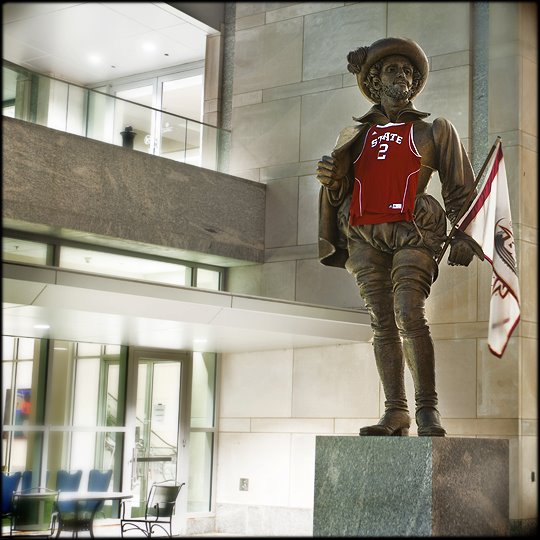
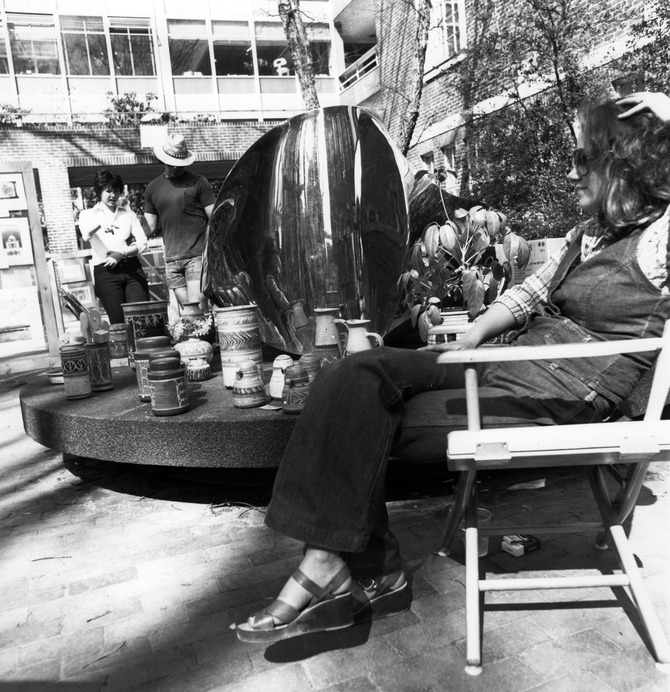
The first NCSU library was located on the second floor of Holladay Hall, but this is the location of the first D.H. Hill Library. In 1926 this building was constructed and named in honor of one time librarian and later president of NCSU, Daniel Harvey Hill, Jr. The senior D.H. Hill was a Confederate general during the Civil War and brother-in-law to Stonewall Jackson, considered by many to be one of the most talented military leaders in United States history.
(Read the rest of this article …)


Following up on the last post about the Free Expression Tunnel, here are more recent images. Pictured above are Kyle and Matt.
Someone made a passionate plea in The Technician last year for higher quality graffiti and less of the familiar fraternity/sorority advertisements:
There are few places you can take cans of spray paint and draw or write whatever you want on a public structure, within law and reason, and get away with it.
However, on campus, we have this luxury in the Free Expression Tunnel and should utilize it to the fullest extent.
Advertisements for sororities and fraternities with the occasional “happy birthday so-and-so” message don’t cut it. We have a design school and many other programs on campus that are meant to foster creativity, but we don’t illustrate that in the tunnel.
Give fellow students something to marvel at as they make the dreadful journey to Harrelson Hall and its extremely uncomfortable seating accommodations.

Did you hear that? It was the sound of Raleigh deflating its population by about thirty thousand people. Almost overnight, Hillsborough Street becomes much more friendly to cyclists, late night pizza joints and bars suddenly cut their hours back, and the amount of open space and peacefulness around NCSU campus seems to open up threefold.
Pictured above is Jacob. He’s an R.A. (and Eagle Scout), and like the rest of them he found himself with a bit of time on his hands as the semester is over and most students have gone back home for the summer or off to their jobs somewhere else. I bumped in to him as he was walking about campus essentially because there wasn’t much else to do as everything suddenly became quiet.
He’s a sophomore majoring in Materials Science.
For the next couple of months there’s a noticable absence of noise and traffic, in addition to the lines at Harris Teeter becoming shorter. There are outdoor festivals and gatherings every weekend.
Regardless of what the Gregorian may tell you, summer has arrived in Raleigh.


I don’t know the story behind the bamboo structures in front of Kilgore Hall. There are several benches and seats which make a beautiful outdoor picnic area.
View Larger Map


So these pictures are of one of the many brick formations at NC State. These in particular are next to Stewart Theatre. If you are interested in Stewart Theatre, check out a virtual tour someone put together.
So, what exactly is the story with these things all over campus? I’ve heard that there used to be many many more. I’ve also heard other stories, about an anonymous donor who donated bricks every year to the university, so these things were built all over with the surplus.
The NC State article on Wikipedia says that
Due to oversupply, odd brick statues dot the landscape, a large section of main campus is paved over with brick (University Plaza, a.k.a. “The Brickyard”), and most sidewalks are also made with brick. These sidewalks are also dotted with white brick mosaics.
An alumni association web page talking about the brickyard has the following Q & A:
An anonymous donor gave NC State the bricks for the university plaza.
FICTION. The bricks were donated but not secretly. The N.C. Bricklayers’ Association provided them. The original design by landscape architect Richard C. Bell ‘50 called for the Brickyard to be built with Belgian block, a hand-cut, granite cobblestone. But that was too expensive. He altered the plans and solicited donations from the brick industry. “Ever since the shift of campus activities in the early ‘60s to the catacombs of the roundhouse and the busy hubbub of the union, people have been screaming about the muddy paths around Harrelson and the bleakness of the quadrangle. Technician editors, student leaders, design students, even secretaries in open-toed sandals have begged, pleaded, and demanded the building of sidewalks in place of the donut’s rickety wooden thresholds and gooey, gray pathways.”
-Technician, May 13, 1966
I can’t help but wonder if the anonymous donor to the brickyard story spawned the ones about the structures. Why was there an oversupply in the first place? Was it left over from building the brickyard? Or just from other donations?